About NAZA
Mission
NAZA is a network of established afterschool providers, each operating in a different geographic zone and with its own particular focus and mission. Each After Zone or Z. provides Metro middle-school students access to afterschool programs that offer meaningful enrichment activities in safe and structured environments. Each Z. is somewhat unique in the programming offered. However, all programs in the Z. have a common commitment to:
- Helping students succeed in school
- Providing activities and experiences that enrich students’ lives
- Providing high quality programming utilizing a Positive Youth Development approach; 5 Principles of Positive Youth Development
- Eliminating transportation and financial barriers for students and families who want to participate
- Using a continuous program quality improvement process, including professional development provided by NAZA
- Manifesting a belief in the value and potential of every student.
History
In May 2009 Mayor Karl Dean launched the Nashville After Zone Alliance in partnership with Metro Nashville Public Schools (MNPS) to fulfill his commitment to develop a coordinated system of afterschool programming for middle school students in Nashville.
This came in response to a key recommendation of the Project for Student Success the previous year. Its findings in part: “The city is sorely lacking in programs and opportunities for middle and high school students in particular. Existing programs may not match the needs of youth in high-risk neighborhoods for accessible locations, targeted social and educational interventions, and hours of operation . . . As proved in numerous national studies, active participation in high-quality afterschool programs in the middle grades leads to higher levels of school engagement, attendance and performance.”
The launch capped six months of intense planning by a team composed of representatives of MNPS, funders, local non-profits, and the Mayor’s Office of Children and Youth. The team discovered that:
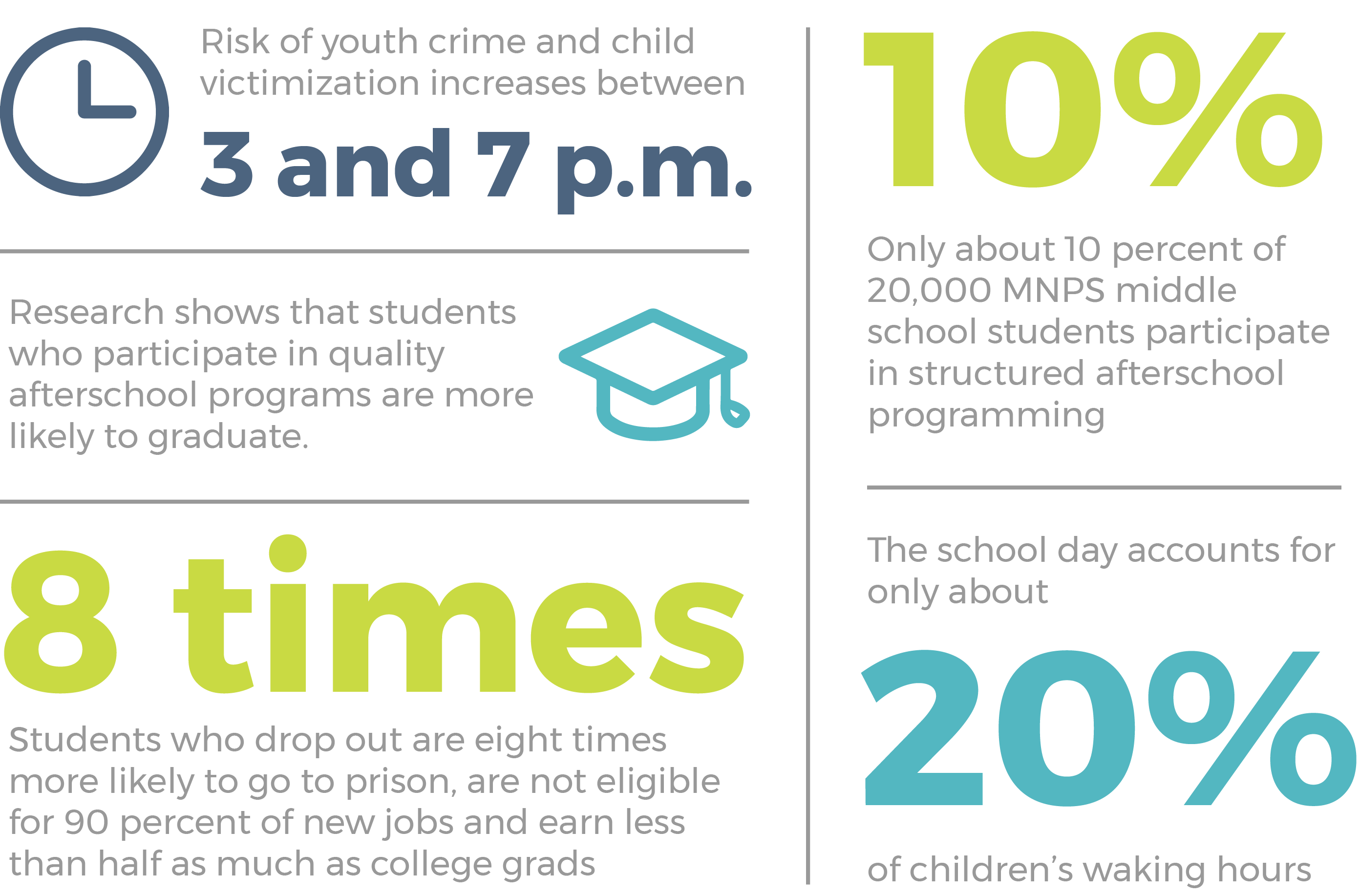
- Fewer than 10% of our 21,500 public middle-school students participate in structured afterschool programs.
- High-quality providers have long waiting lists. Most programs are designed more for elementary students and are not appealing to pre-adolescents, who then disengage.
- Reflecting national data, juvenile crime and child victimization for this age group peaks in the afterschool hours.
After extensive benchmarking with national organizations and other cities, this team drafted a charter, framework and structure, all of which were adopted by NAZA’s Leadership Council.